BOOK PROJECT
Riddles of Women: Mythical, Modernist, Freudian
Riddles of Women reverses Sigmund Freud’s claim that women are “riddles” without solutions by arguing that women are essential for deciphering enigmas of the psyche that his thirty years of research left unanswered. Taking as my point of departure Freud’s reading of a little-known literary text entitled Gradiva (“she who walks”), I develop a theory of real and imagined “women who walk” across his most perplexing cases, one that I call “The Gradiva Complex.” The “Gradiva Complex” displaces Freud’s “Oedipus complex” through triangulations of mythical figures, modernist characters, and Freudian analysands that are unfixed and transit across space and time. Moving fluidly among classical mythologies (of Echo, Eve, and Athena), modernist writings (by E.M. Forster, Katherine Mansfield, and H.D.), and Freudian cases (on hysteria, perversion, and neurosis), these uncanny trios help readers think anew fundamental psychoanalytic concepts—from free association to psychic mastery. Contrary to the tragic drama of Freud’s Oedipus, these Gradiva figures ultimately reveal a hidden history of psychoanalysis, one in which questions of death become life, psychosexual fixations are surpassed by psychosocial processes, and women themselves become keys to understanding Freud’s long-lasting impact on debates over gender, race, and reproduction in our present.
For a brief video overview of Riddles of Women, click here.
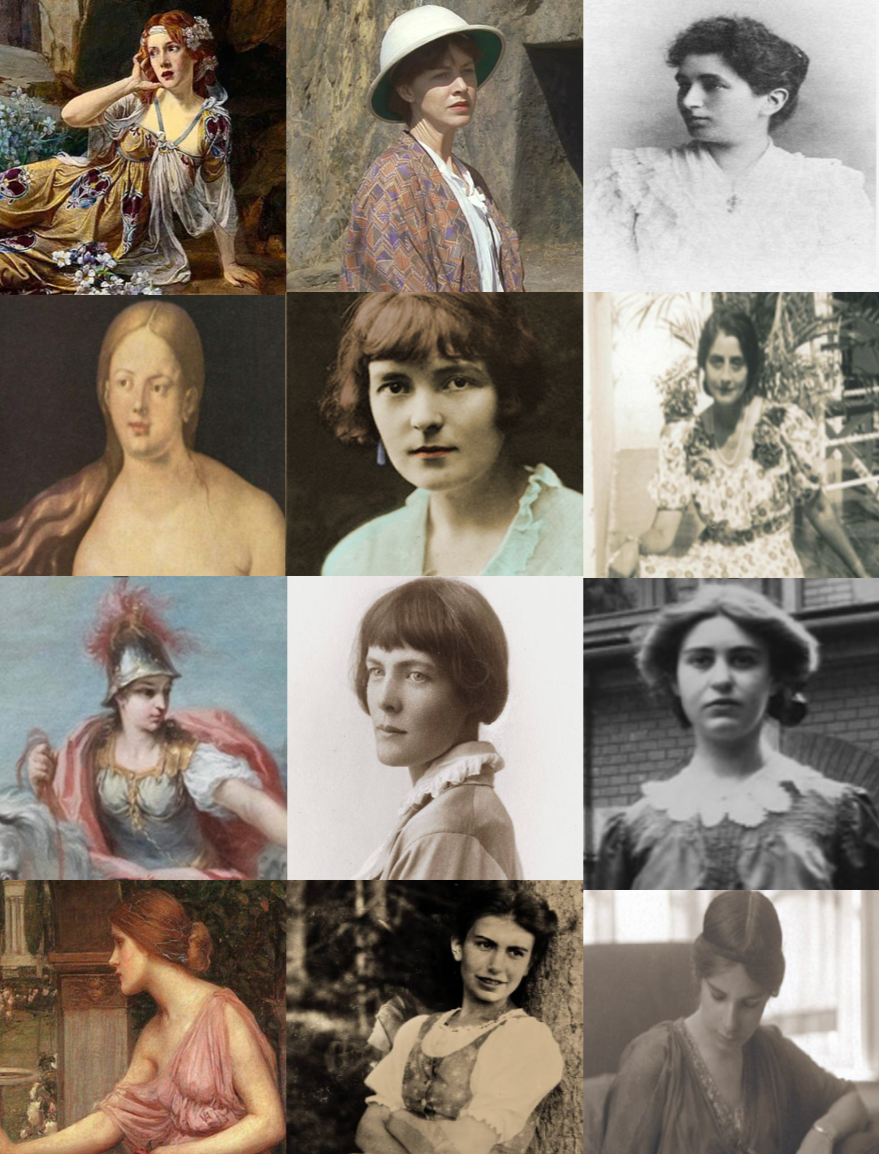
Figures from left to right: Echo, Adela Quested, Emma Eckstein, Eve, Katherine Mansfield, Margarethe Csonka, Clorinda, H.D. Sofie Freud, Psyche, Anna Freud, Dorothy Burlingham